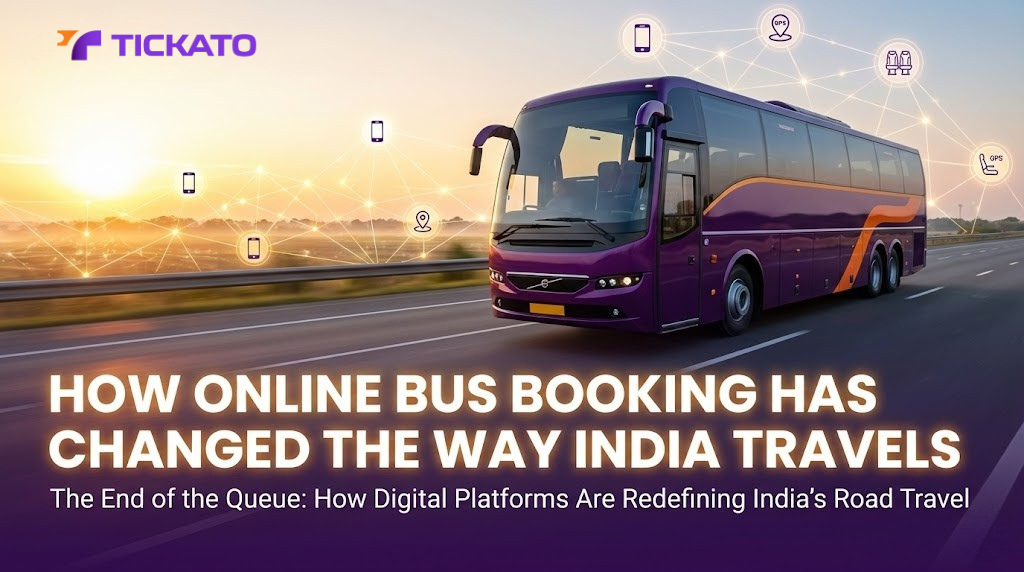
The End of the Queue: How Digital Platforms Are Redefining India’s Road Travel
Not long ago, booking an intercity bus ticket in India was an exercise in patience and uncertainty. It meant standing in chaotic queues at crowded terminals, dealing with cash-only counters, and boarding a bus with no idea if your “window seat” was actually a window seat.
Today, that narrative has flipped. The Indian bus travel market is undergoing a massive digital transformation, moving from a disorganized, volume-based sector to a technology-driven, premium experience. As we step into 2026, online platforms are not just selling tickets—they are selling certainty, comfort, and a new standard of travel.
1. The Digital Shift: By the Numbers
The migration from offline counters to online platforms is no longer a slow trickle – it is a flood. The online bus ticketing market in India has seen explosive growth, with projections estimating the market value was expected to reach approximately $7.32 billion by 2025.
This surge is driven by a young, tech-savvy population that demands efficiency. With internet penetration deepening and smartphone usage ubiquitious, travelers are abandoning the “agent” model for the autonomy of apps. The data is clear: online aggregators are registering the steepest growth rates (over 10% CAGR), outpacing traditional offline channels as millennials and business travelers dominate the new patronage.
2. The “Certainty” Revolution
The biggest disruption online platforms have introduced is transparency. In the traditional model, a traveler’s journey began with anxiety: Will the bus be on time? Is the seat broken?
Modern digital platforms have solved these pain points by offering:
- Visual Seat Selection: Travelers can now view layout maps and choose specific seats, eliminating the “bad seat” surprise.
- Live Tracking: GPS integration has made “waiting in the dark” a thing of the past, improving safety and reliability.
- Amenity Transparency: Knowing beforehand if a bus has Wi-Fi, blankets, or charging points has shifted the power back to the consumer.
3. The Rise of the “Premium” Traveler
Perhaps the most significant shift in 2025-26 is the “Premiumisation” of bus travel. The Indian traveler is no longer just looking for the cheapest seat; they are willing to pay for comfort.
Recent industry reports indicate that intercity bus occupancy hit a record 79% in 2025, driven largely by a surge in demand for premium and luxury routes. The average revenue per trip has risen significantly, signaling that travelers are increasingly opting for AC Sleepers, Multi-axle Volvos, and “Business Class” road travel over standard options.
This trend is particularly strong on long-haul routes (overnight journeys), where the comfort of a sleeper bus often rivals that of a train or a budget flight. Premium buses are forecasted to increase their revenue share significantly by 2030 as operators monetize this demand for comfort and productivity.
4. The Road Ahead
The future of Indian bus travel is seamless, cashless, and luxurious. We are moving toward an ecosystem where AI predicts demand to optimize fleet deployment, and where a single click ensures a door-to-door premium experience.
For brands like Tickato, this evolution is the baseline. The modern traveler doesn’t just want a ticket; they want a guarantee of quality. As the infrastructure improves and digital adoption hits 100%, the bus is no longer the “alternative” mode of transport – it is becoming the preferred choice for the smart, discerning Indian traveler.